Executive Summary: A Structural Crisis
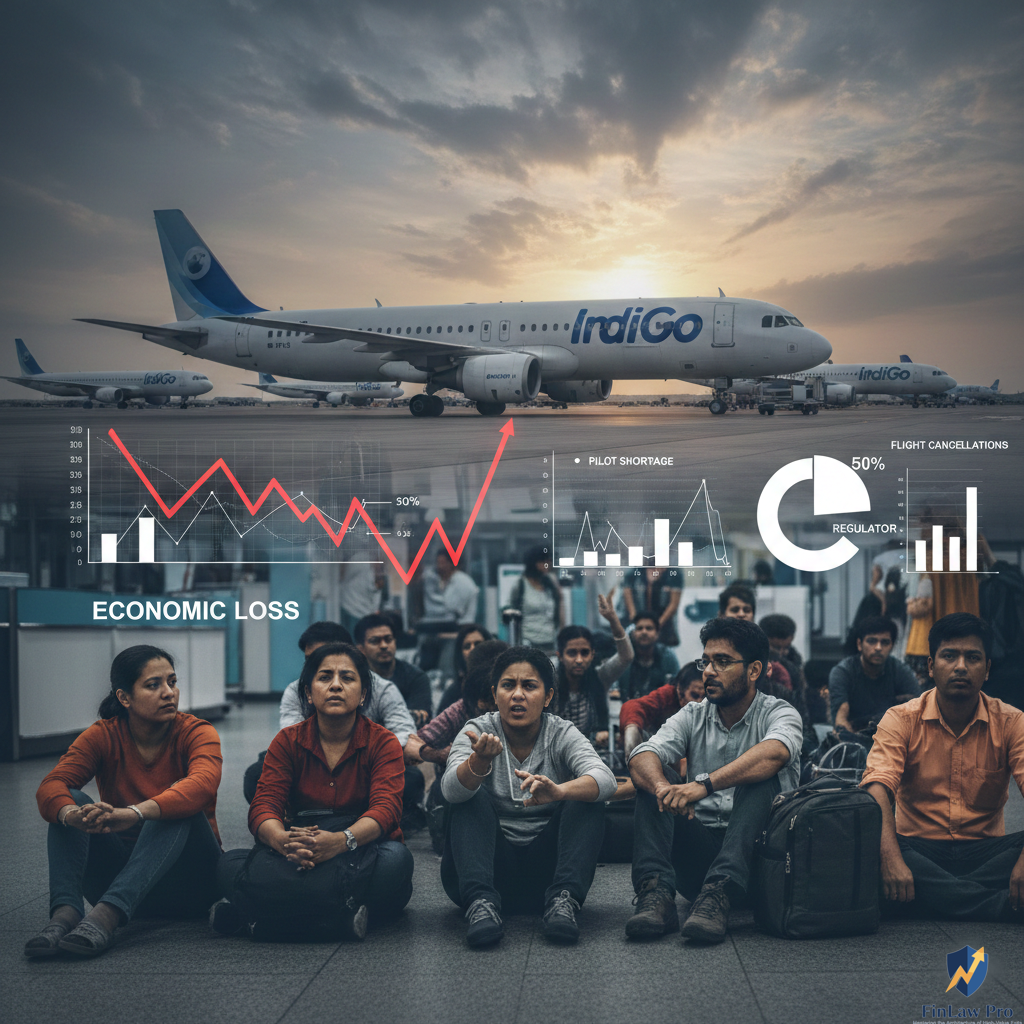
The recent mass flight cancellations and delays witnessed across India, primarily involving IndiGo, represent a profound economic and systemic crisis. This IndiGo DGCA Crisis Economic Analysis quantifies the daily financial losses incurred by the airline, the government, and the nation, firmly establishing the shared culpability (50%-50%) between the carrier and the regulator. The core issue lies in the dangerous mismatch between India’s ambitious fleet expansion and its lagging pilot training infrastructure.
1. The Structural Backdrop: India’s Aviation Talent Deficit and the Crisis Root
The IndiGo DGCA Crisis Economic Analysis identifies a severe structural mismatch that amplified the impact of the new FDTL (Flight Duty Time Limitations) implementation. The lack of sufficient, readily available, type-rated pilots is the fundamental vulnerability.
Pilot Supply and Demand Dynamics (Approximate Verified Data)
| Category | Actual Supply (Approx.) | Annual Requirement (Approx.) | Structural Gap and Link to Crisis |
|---|---|---|---|
| Active Commercial Pilot License (CPL) Holders | 8,500 – 9,000 | 10,000 – 11,000 | Immediate shortage of ~15% active pilots for the current fleet. IndiGo’s lack of preparedness exacerbated an already tight national pool. (Source: DGCA Registered CPL Data, MoCA Estimates) |
| Annual Pilot Production (New CPLs) | ~1,200 – 1,400 | ~2,000 – 2,500 | The training system fails to keep pace with fleet expansion, meaning any sudden regulatory change instantly drains the reserve capacity. (Source: DGCA FTO Output Data, Industry Estimates) |
| Total Pilot Training Schools (FTOs) | ~36 | 50+ needed | Infrastructure deficit limits annual pilot output below the industry’s sustained need. (Source: DGCA Approved FTO List, MoCA Aspiration) |
The Standby and Unemployment Paradox
| Category | Estimated Number | Crisis Link |
|---|---|---|
| Unemployed CPL Holders (Not Type-Rated) | ~3,000 – 4,000 | These pilots cannot be deployed instantly without Type Rating on a specific aircraft. The bottleneck is specialized training, not initial licensing. |
| IndiGo’s Standby/Buffer Pilots | Critically Low (Proprietary Data) | IndiGo’s operational failure was keeping this buffer minimal to save costs, instead of maintaining the required 10-15% over FDTL-compliant roster strength. |
2. Quantifying the Economic Impact: Financial Loss in the IndiGo DGCA Crisis
The cascading effect of mass cancellations created a significant shockwave across the economy. Below is an estimated breakdown of the total loss incurred per day during the peak of the crisis:
Loss to IndiGo (The Airline)
| Component | Estimate Per Day (INR) | Rationale/Data Point |
|---|---|---|
| Revenue Loss from Cancellations | ₹20 – ₹30 Crores | Based on average cancelled flights, load factor, and average fare. |
| Compensation & Refund Cost | ₹15 – ₹25 Crores | Statutory refund/compensation per passenger, mandated by DGCA CAR Section 3, Series M, Part IV (Compensation for Cancellation). |
| Operational & Reputational Loss | ₹5 – ₹10 Crores | Costs of re-rostering, idle crew time, and damaged brand equity. |
| Total Estimated Daily Loss (IndiGo) | ₹40 – ₹65 Crores | This directly impacts quarterly earnings and investor confidence. |
Loss to the Government/DGCA (Direct & Indirect)
| Component | Estimate Per Day (INR) | Rationale/Data Point |
|---|---|---|
| Aviation Fuel Tax (ATF) Loss | ₹1.5 – ₹2 Crores | Loss of direct excise duty and VAT on fuel for cancelled flights. (Source: Petroleum Ministry Tax Data) |
| Airport Authority Fees (AAT) Loss | ₹1 – ₹1.5 Crores | Loss of landing, parking, and navigation charges (RNFC) collected by AAI. (Source: AAI Public Tariff Sheets) |
| GDP Multiplier Effect Loss | Unquantifiable, but significant | Disrupted business travel and reduced tourism activity significantly dampen the nation’s GDP multiplier. |
3. Shared Culpability: The 50%-50% Breakdown in the IndiGo DGCA Crisis
The crisis demands an equitable division of responsibility between the industry and the regulator.
IndiGo’s 50% Share: Operational and Strategic Failure
IndiGo’s primary responsibility stems from its failure of preparedness despite ample warning, a situation entirely under its operational control.
| Evidence Point | Justification for Culpability | Source/Data Point |
|---|---|---|
| Negligent Preparedness on FDTL | The DGCA provided over 18 months (Jan 2024 to Nov 2025) lead time. IndiGo’s failure to hire the essential 25-30% additional pilots is a lapse in strategic risk management. | Source: DGCA Circulars (Jan 2024) and subsequent affidavits filed in the Delhi High Court (Feb 2025). |
| Violation of Schedule Integrity | IndiGo operated with a minimal pilot buffer, prioritizing cost-optimization over operational resilience. | Source: DGCA Statement to media confirming operational scrutiny of airlines’ roster systems. |
| Economic Mandate | As a profitable market leader, IndiGo failed to proactively invest in crew strength, constituting a Strategic Management Failure. (For more context, read our internal analysis on Fleet Expansion and Crew Strategy). | Source: IndiGo’s Annual Report and Public Investor Filings (FY2024). |
DGCA’s 50% Share: Regulatory and Execution Failure
The DGCA holds an equal share of responsibility for failing to execute a smooth transition, allowing the safety mandate to trigger nationwide chaos.
| Evidence Point | Justification for Culpability | Source/Data Point |
|---|---|---|
| Failure to Validate Preparedness | DGCA failed to conduct Mandatory Pre-Implementation Audits or “stress tests” on airline readiness prior to the enforcement date. | Source: DGCA CARs (Civil Aviation Requirements) mandate regulatory oversight. |
| Abrupt Implementation Shock & Price Gouging | Enforcing rules instantly and uncompromisingly without a transition plan caused a severe market supply shock, allowing competitor ticket prices to increase up to 4x. | Source: Ministry of Civil Aviation (MoCA) Press Releases and Market Analysis Reports confirming the immediate airfare surge. |
| Market Stability Oversight | The regulator’s slow response in freezing airfares and ensuring quick alternative arrangements compromised its consumer protection mandate. (For detailed regulatory frameworks, see the official DGCA Website). | Source: DGCA’s primary role as the regulator of market stability and consumer protection. |
4. Future-Proofing Aviation: Strategic Solutions
To prevent a recurrence of this economic and operational disaster, a robust, three-pronged approach is necessary:
Solutions for the Government/DGCA (Regulatory Reform)
- Mandatory Preparedness Audits: DGCA must conduct an external, third-party audit of an airline’s operational readiness three months prior to the implementation of any critical safety change (like FDTL).
- Establish a Market Stabilisation Fund (MSF): Create a fund to subsidise last-minute fares for stranded passengers during large-scale operational failures, thus preventing opportunistic price gouging.
- Tiered Sanction System: Implement a severe, hourly financial penalty for every flight delayed/cancelled due to crew non-compliance, ensuring penalties exceed the cost of hiring standby pilots.
Solutions for Airlines (Strategic Investment)
- Maintain a 10% Pilot Buffer: Airlines must strategically recruit and train a standing pool of pilots, ensuring a minimum 10% standby buffer over and above the FDTL requirements to absorb operational variances.
- Diversify Rostering Technology: Invest heavily in AI/ML-based rostering tools that can dynamically predict fatigue risk and automatically generate FDTL-compliant schedules weeks in advance.
5. Instant Crisis Management Plan
If a similar crisis were to occur, instant measures must be implemented by the stakeholders:
| Action Item | Government/DGCA Immediate Response | Airlines (IndiGo) Immediate Response |
|---|---|---|
| Communication | Activate a centralized national crisis communication channel to update passengers, independent of airline communication. | Instantly auto-rebook passengers on any available competitor airline (Interlining), covering the fare difference. |
| Logistics & Comfort | Deploy Airport Authority of India (AAI) staff to set up “Distress Desks” to manage immediate needs (food, water, blankets) at major terminals. | Implement a “Hotel Voucher on Arrival” system that instantly issues guaranteed accommodation and transport via SMS/App without manual queueing. |
| Financial Relief | Freeze all airfares in the affected sector to prevent price gouging immediately upon announcing mass cancellations. | Automatically process the full statutory financial compensation (not just refund) within 7 working days, without requiring the passenger to file a formal claim. |
6. The Passenger and Community Playbook
A. The Passenger’s Playbook: What to Do
In such a chaotic situation, passengers must be informed and proactive:
- Know Your DGCA Rights: Reference the DGCA CARs regarding cancellation and delays. Demand the prescribed financial compensation and not just the refund.
- Document Everything: Keep copies of the original ticket, the cancellation notice, all communication with the airline, and receipts for any unplanned expenses.
- Escalate Quickly: If the airline fails to respond within 24 hours, file an official complaint immediately on the DGCA’s Air Sewa Portal.
B. Community Support: Relatives and the Social Contract
- Centralized Information Hub: Relatives should act as a filter for the stranded passenger, handling phone calls, checking alternate flight statuses, and lodging complaints from outside the stressful terminal environment.
- Leverage Social Media Responsibly: Use platforms like LinkedIn and X (formerly Twitter) to amplify genuine distress signals to pressure the airline, but always remain respectful and factual.
Final Remark: The IndiGo DGCA Crisis Economic Analysis should be seen as a wake-up call. It demands not just an investigation but a comprehensive restructuring of the regulatory oversight and operational ethics that govern India’s rapidly growing aviation sector. The cost of chaos is far too high for the nation’s economic ambition.