
Part I: The Problem — The Industrial Echo Chamber
1. The Audacity of Standardization
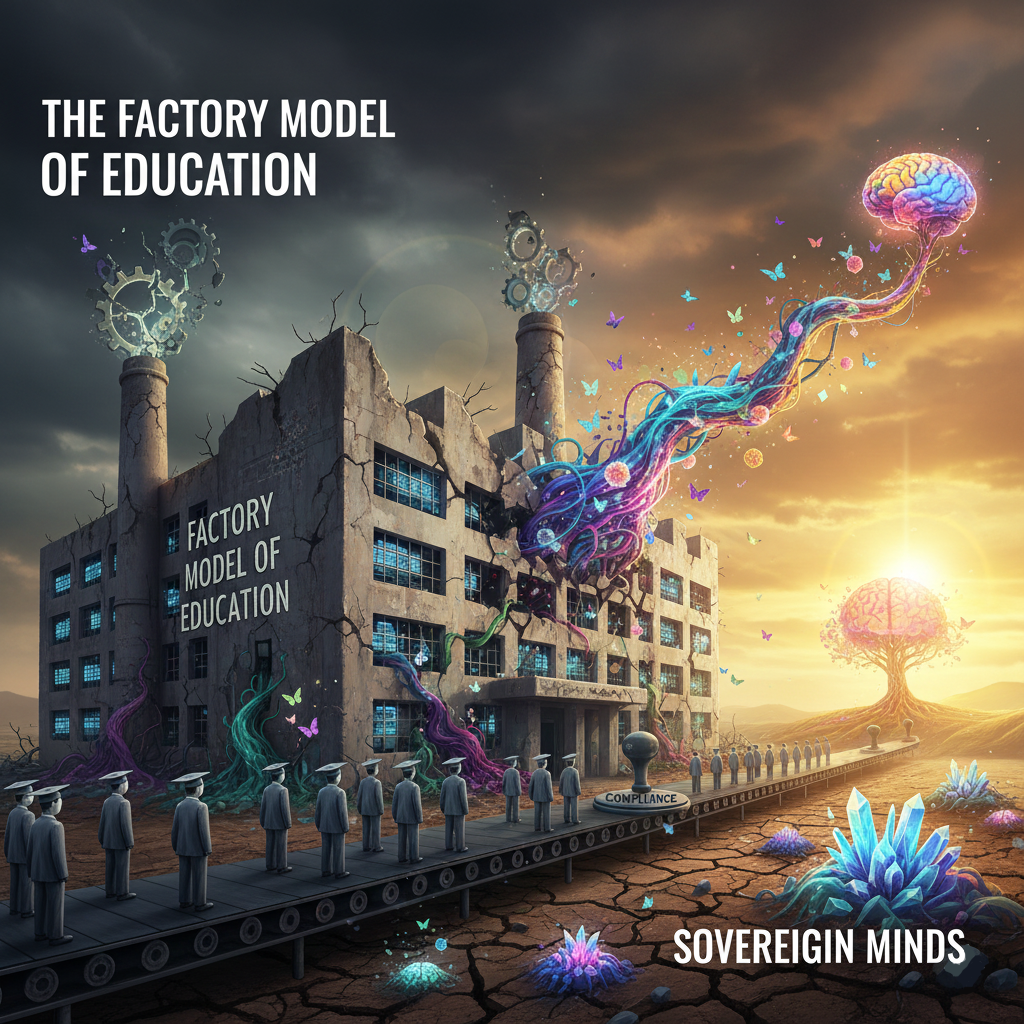
The Factory Model of Education: The fundamental failure of modern education lies in a rarely challenged premise: that human curiosity, growth, and learning can be standardized and processed. Our present system, globally recognized through its familiar architectural and functional tropes—the ringing bell, the segmented batch-processing of age groups, the fixed assembly line of curriculum, and the conveyor belt of standardized testing—is not a product of psychological or pedagogical insight. It is an echo.
This entire framework is, structurally and ideologically, a faithful relic of the 19th-century Industrial Revolution.
2. The Factory Floor vs. The Sovereign Mind
The purpose of the early industrial model was clear: mass production demands uniformity, obedience, and predictable output. The school system was designed not to produce thinkers, creators, or innovators, but to efficiently manufacture obedient and standardized workers suitable for the factory floor or the bureaucratic administration.
Consider the elements:
- The Bell: A signal for compliance and the arbitrary termination of focus.
- The Assembly Line: Students move lock-step through grade levels, regardless of individual mastery or pace.
- The Product (Student): Graded based on conformity to a standardized test, proving their utility, not their sovereignty of thought.
This established an inherent paradox: we use a system designed for predictable, repetitive industrial obedience to supposedly create the very opposite: flexible, creative, and critical thinkers for the digital age.
3. The Central Thesis: An Obsolete Algorithm
The industrial model was successful because its goal—the reliable transmission of pre-approved information—was simple. However, in the 21st century, where information is ubiquitous and the core human value is the ability to synthesize, critique, and create new knowledge, the system is catastrophically obsolete.
It has confused the means with the end: it measures the efficiency of the process (how well students pass tests) rather than the quality of the intellectual output (how capable students are of generating original ideas and solving ambiguous problems).
The question is not whether the factory system works, but whether this Factory Model of Education is still serving the right purpose. We are using an algorithm designed for 1880 to solve the challenges of 2025.
Part II: The Consequence — The Erosion of Sovereign Minds under the Factory Model of Education
1. The Fetishization of Compliance
The industrial model prioritized conformity over all else. This system fosters a deep-seated Fetishization of Compliance. It teaches the student that the solution is less important than the path to the solution dictated by the authority. This is the opposite of sovereign thought, which demands Intellectual Risk-Taking and Ambiguity Tolerance.
By rewarding students primarily for memorization and accurate repetition, the system trains the mind for intellectual submission, rendering it incapable of navigating the complex, non-linear problems of the real world.
2. The Death of Boredom and Deep Thought
A key component of profound thought and creativity—the state of boredom and unstructured contemplation—is actively eliminated by the factory school schedule. The fragmented school day treats the mind like a machine that can be switched on and off at 40-minute intervals. This environment produces “information collectors” but systematically fails to cultivate “knowledge creators.”
3. The Illusion of Mastery and the Failure of Critical Critique
Standardized testing is the factory’s final quality control check. It successfully measures conformity but creates a dangerous illusion of mastery. The true sovereign mind must possess Meta-Cognition and Conceptual Disruption. When the Factory Model of Education punishes the non-standard answer and rewards regurgitation, it prepares students not for innovation, but for lifelong employment within rigid hierarchies.
Part III: The Solution — Building the Learning Ecosystem
1. The Paradigm Shift: From Manufacturing to Cultivation
The primary step in establishing the Learning Ecosystem is a foundational ideological shift: learning must move from being viewed as an “Output” to being viewed as a “Continuous Process of Synthesis.” The objective is not the efficient production of knowledge-consumers but the cultivation of knowledge-creators. This requires rejecting the industrial metaphor entirely and adopting an ecological model, where the environment supports diverse, organic growth.
2. Deconstructing the Factory: Time, Space, and Assessment
To build the sovereign mind, we must dismantle the three pillars of the industrial relic:
- A. Time: Eliminating the Bell: Learning must become Autonomous and Asynchronous. The student, rather than the bell, dictates the pace of intellectual digestion.
- B. Space: From Classrooms to Labs: The standardized classroom must evolve into fluid, purpose-driven Learning Labs designed for interdisciplinary synthesis.
- C. Assessment: The Mastery Portfolio: Standardized testing must be replaced by Mastery Portfolios, reviewing original work and genuine problem-solving capabilities.
3. The Cultivation of Sovereignty: The Three Pillars
The Learning Ecosystem must be actively structured around developing the capacities that the Factory Model of Education suppresses:
- I. The Role of Mentorship (Replacing the Manager): The teacher shifts from being a curriculum manager to an Intellectual Mentor.
- II. The Focus on Mastery (Replacing the Assembly Line): The educational journey must prioritize Mastery over Chronology. Students advance based on demonstrated comprehension of complex concepts, not chronological age.
- III. The Creation of the Masterpiece (Replacing the Product): The capstone of learning must be the creation of an Original Masterpiece—a project where the student synthesizes learned knowledge to solve a real-world problem. This final act affirms the student’s status as a Knowledge Creator and a Sovereign Mind.
By making this fundamental transition—from a system engineered for industrial obedience to an ecosystem designed for intellectual autonomy—we can finally empower the next generation to tackle the non-linear challenges of the 21st century.

I really like your blog.. very nice colors & theme.
Did you make this website yourself or did you hire someone to do
it for you? Plz answer back as I’m looking to create my own blog and would like to find out
where u got this from. thank you
Thanks mate, Yeah all things start from scratch so it is.
If you want help with your blog I can please email me the details on what you are upto