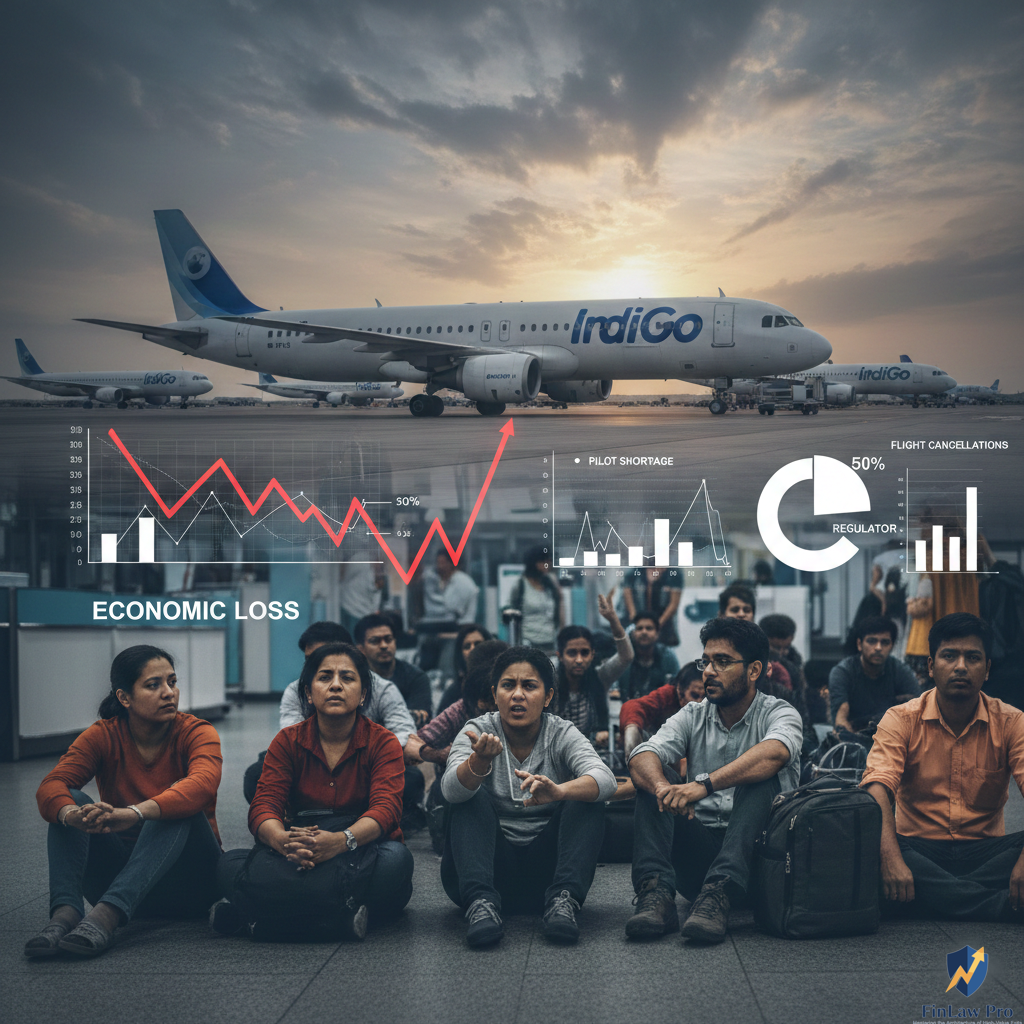
1. Introduction: History’s Shadow and Structural Anxiety
The political battlefield today is choked with accusations of Crony Capitalism India. This critique has a deep historical root. In 1600, the East India Company (EIC) received a ‘Royal Charter,’ an instrument that translated the State’s sovereignty into a tool for private commercial monopoly. This was not mere capitalism; it was State-sanctioned economic warfare. The EIC’s dominance remains history’s most potent example of the dangers inherent when the State and private capital form a privileged nexus.
The modern discourse is fueled by this legacy. This critique, often raised by parties with their own complex economic histories, is an unconscious reflection of a structural anxiety—the deep-seated fear that private power is, once again, co-opting the State. Analyzing the current debate requires us to look beyond simple corruption charges and examine the structural, policy-driven mechanisms that concentrate national wealth and risk. The structural foundation of Crony Capitalism India often mirrors this EIC patronage model through policy mechanisms. This paper analyzes the modern critique using the most contentious case study: the privatization of India’s strategic airport assets.
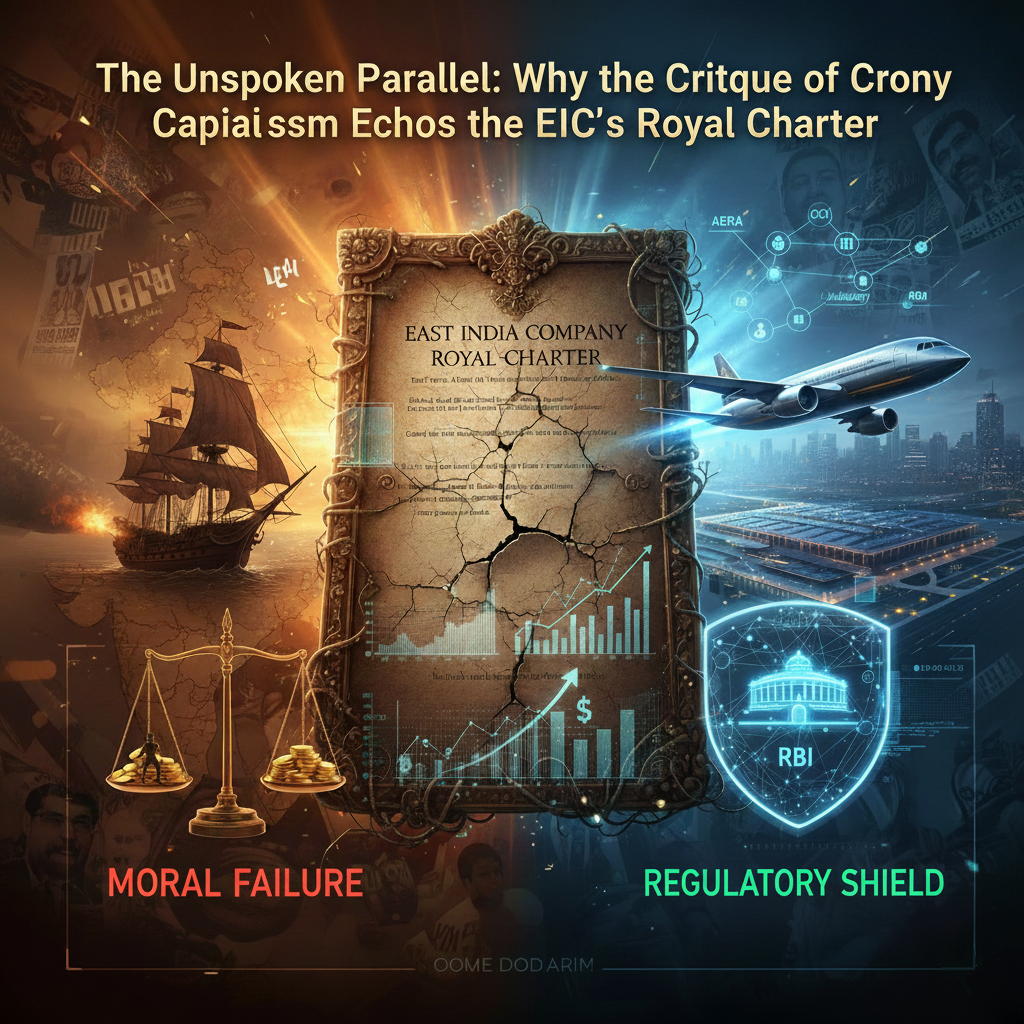
2. Analysis of the Structural Resemblance: The Implied Charter
The modern critique finds powerful resonance in the EIC’s operational structure, as both highlight the danger of an implicit or explicit State-sanctioned charter.
A. The Nature of the Implied Charter (Policy-based Patronage):
The EIC’s power was codified by a document. Today, the critique posits that policy amendments—not formal charters—act as the modern ‘Royal Charter’. These amendments, such as the removal of restrictive clauses in tenders, are seen to facilitate the rapid dominance of specific groups in strategic national assets (Ports, Energy, Logistics). The charge is that the State is not merely facilitating business; it is streamlining the pathway for singular dominance.
B. Leveraging State Power for Private Gain (The Rent-Seeking Model):
The EIC leveraged the Crown’s military and diplomatic might for private profit—a classic example of rent-seeking. Similarly, the modern charge alleges that corporate groups leverage State-controlled financial mechanisms (access to bank loans, governmental backing, and diplomatic support for overseas expansion) to engineer rapid, high-risk growth. This dangerous fusion of public resource and private ambition is central to the structural fear. The economic distortion arises when profitability is derived more from political relationships than from market efficiency. This creates a system where strategic sectors become highly vulnerable to the financial stability of a single entity.
3. Case Study: The 2019 Airport Privatization and the Regulatory Firewall
This section examines the 2019 privatization of six major AAI airports (Lucknow, Ahmedabad, Mangaluru, Jaipur, Guwahati, Thiruvananthapuram) as the central case study demonstrating the tension between legal policy and structural risk.
A. The Economic Context and Policy Decision
The government’s primary goal was to maximize revenue from state assets. The key policy decision was the removal of the ‘prior experience’ clause, which legally expanded the pool of bidders beyond incumbent airport operators.
| Economic Strategy: EIC vs. Modern Privatization | EIC Model (17th Century) | Modern Airport Concession (21st Century) |
| Monopoly Source | Royal Charter (Explicit State Grant) | Policy Change + Aggressive Bidding (Legal Procedure) |
| Pricing Control | Unfettered (Full Power to Exploit) | Regulated by AERA (Limited Power) |
| Core Goal for State | Political Control & Trade Favoritism | Maximum Revenue (Highest Per-Passenger Fee) |
| Strategic Risk | Centralized Risk (Crown) | Concentrated Risk (Six Major Airports to one group) |
B. The Paradox of Outcome (The Moral Failure)
The procedural legality of the tender (upheld by the Supreme Court) resulted in a statistically improbable outcome: one single group won all six strategic airports by submitting the highest per-passenger fee bid in each case. While financially excellent for the state exchequer, the outcome created a high concentration of national strategic risk. The moral failure lies in the fact that a procedurally correct policy actively facilitated the very market concentration that public policy ethics (and the CCI) are mandated to prevent. The structural flaw is evident in the risk management failure.
C. The Regulatory Firewall: Nullifying the Monopoly Power
The most critical argument refuting the charge of an “unfettered monopoly” and the “double standard” is the existence of the regulatory mechanism:
- AERA’s Mandate: The Airports Economic Regulatory Authority of India (AERA), established by the AERA Act, 2008, controls the economic power of the operator.
- Price Control: AERA is the independent body that controls and approves all tariffs (User Development Fee, Landing, and Parking charges). The private operator cannot arbitrarily exploit its concentrated position by raising fees.
- Case Conclusion: This regulatory control ensures that the outcome, though concentrated, does not possess the unchecked pricing power characteristic of the historical EIC model. The ‘double standard’ charge, therefore, exists primarily in political rhetoric, not in the regulatory reality overseen by AERA.
4. Structural Dissimilarities: Why Political Hysteria Misses the Mark
The critique suffers from historical blindness. Modern Crony Capitalism India—despite its challenges—operates under checks and balances absent during the EIC’s rise.
A. The Indivisibility of Sovereignty: The EIC model involved the fragmentation of sovereignty, as the company essentially took on state functions (military, taxation). Modern Corporate Groups cannot usurp the State’s power. Sovereignty remains indivisible, locked within the Constitution of India.
B. Accountability and Statutory Framework: The EIC operated under limited oversight. Modern Crony Capitalism India—despite its challenges—operates under relentless scrutiny from a vast statutory network. The corporations are subject to SEBI (capital markets), the Judiciary (public interest litigation), AERA (infrastructure pricing), and the RBI (financial stability). This vast web of accountability was entirely absent during the EIC’s rise. This framework acts as a critical institutional defence against a complete structural takeover.
5. Conclusion: The Structural Warning and Political Hypocrisy
The Crony Capitalism India debate is a necessary structural warning, but it is polluted by political hypocrisy. The opposition attempts to project its own structural anxieties onto the ruling party. The ultimate lesson from the EIC is that the State must never subordinate public interest to private ambition.
The true danger is not a corporate group winning legal bids, but the corruption of the political process itself through opaque funding and lobbying, which undermines democratic institutions. The Constitution must always remain the supreme charter, ensuring that economic progress is governed by transparency, fair competition, and strict accountability, serving the national interest and not the exclusive privilege of a select few.