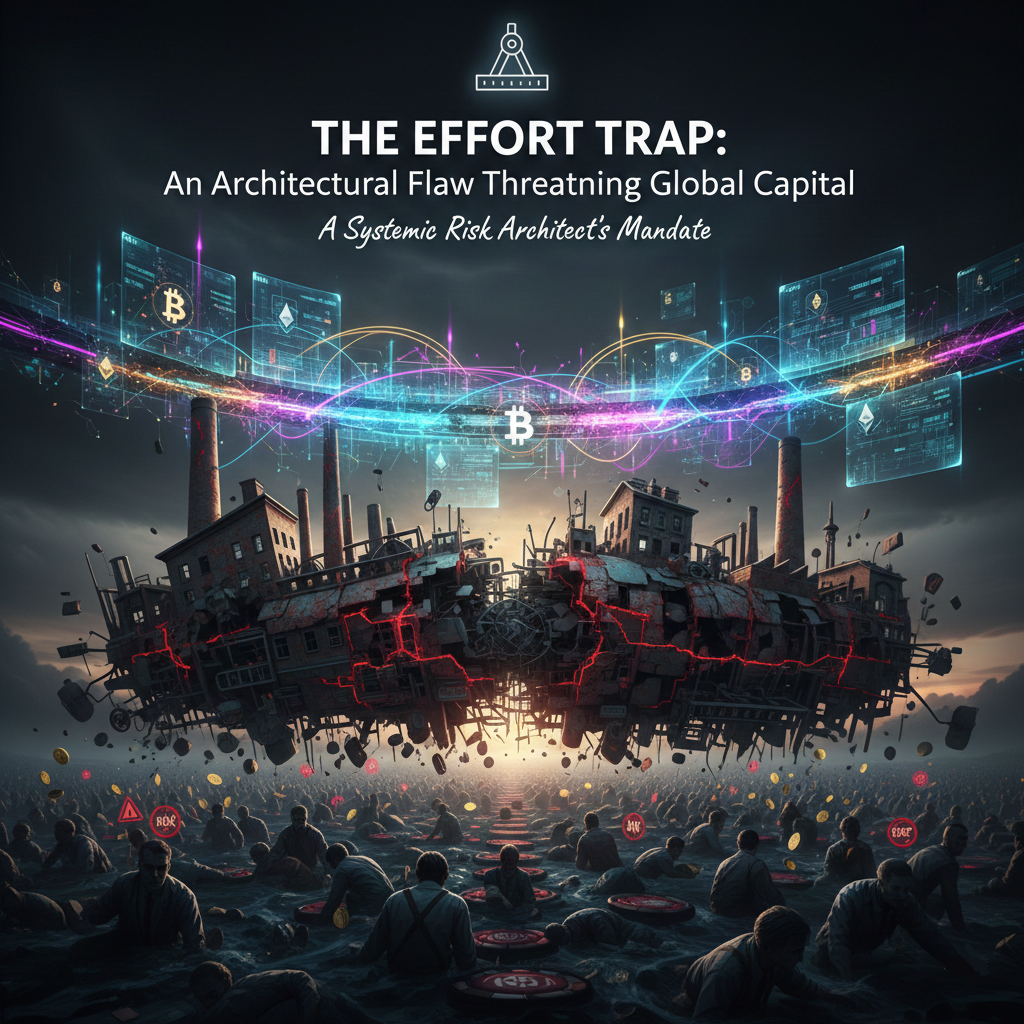
Systemic Risk Capitalism presents is an urgent topic we must confront today. We must discuss the phenomenon widely termed the “Effort Trap.” Why? Because it is not a labor crisis; it is an Architectural Flaw in the capitalist model that poses a direct Systemic Risk to the very capital it is designed to serve.
We have engineered an economic engine since the early 1800s where the immense output of the working base results in a disproportionate accumulation of risk rather than reward. This creates an unsustainable structural design that must be addressed immediately by every investor and CEO globally.
1. Money, Value, and the Systemic Foundation of Wealth
Let’s establish the fundamental relationship. If someone asks me about the core of our economy, I emphasize this: Money is the indispensable abstract foundation that defines human civilization.
Capitalism is the operational system we built to manage this foundational abstract value. The failure begins when the pursuit of short-term Personal Gain structurally undermines the Group Benefit necessary for the system’s longevity. This internal conflict is a breeding ground for Systemic Risk.
2. The 1800s Blueprint: The Genesis of Wealth Inequality
The root of this architectural flaw lies in the original design blueprint of the Industrial Revolution. This structure was optimized for rapid capital accumulation.
The data confirms the divergence: during the crucial phase of industrialization, the worker’s real wages remained largely stagnant while output per worker was expanding rapidly. This Systemic Leakage created a top-heavy structure where capital’s profits became directly dependent on the sustained suppression of the operational base. This design flaw, established over two centuries ago, continues to undermine market confidence and economic equilibrium today. This is an inherent risk, one that challenges the resilience of Systemic Risk Capitalism.
3. Risk Architecture: Learning from the Wolf Pack Paradox
The criticality of balancing personal and group interests is perfectly illustrated by the wolf pack paradox. The minute an individual wolf is incentivized to prioritize personal gain over the pack’s sustained hunting capability, the entire resource generation mechanism collapses.
The Application to Capital: When the operational base feels exploited, the motivation and long-term commitment are withdrawn. This internal conflict acts as a systemic volatility factor that jeopardizes the entire enterprise’s future.
4. Compensation Models: Unacceptable Volatility and the Casino Effect
The modern compensation model is the most acute manifestation of this architectural flaw. I view the return for work not as profit, but as compensation designed to ensure system stability.
The current system functions as a gamble: success is rewarded, but failure immediately shifts the financial burden and risk onto the worker. This model systematically fails to incentivize sustained excellence, fostering instead a short-term, opportunistic mindset. This degradation of quality and trust is a direct cost to the capital owner. This is not stable business; it is unacceptable systemic volatility.
The Modern Data Confirms the Risk: The extreme load bearing (richest 10% taking over 50% of global incomes) on capital is inherently fragile. The structural imbalance means the capital owner is losing the most valuable asset. This amplifies the need to mitigate the challenges presented by Systemic Risk Capitalism.
Conclusion: The Mandate for Systemic Resilience in the Digital Age
The need for this re-architecture is not merely a vision; with the advent of decentralized technologies, the solutions are no longer purely conceptual.
The choice for the modern leader is stark: Do we continue with the reactive 1800s approach, or do we demand a fundamental re-architecture?
My mandate as a Systemic Risk Architect is clear: to identify these deep-seated design flaws and build resilience into the system. The time has come to stabilize the productive base—not out of charity, but out of strategic necessity to secure and maximize the long-term return on capital and minimize the inherent Systemic Risk Capitalism currently endures.