
AI User Data Valuation and Liability is the critical financial challenge facing the modern tech industry. The Artificial Intelligence revolution has delivered unparalleled efficiency, but this convenience carries a significant, often unacknowledged price. The truth behind the seemingly “free” exchange of AI is an Undervalued Liability on the balance sheet of every major tech firm. This exchange, often termed the digital “Barter System,” accelerates AI progress while demanding users’ most valuable assets: time and proprietary data. This analysis delves into the critical need for AI User Data Valuation and Liability, arguing that this significant compensation risk must be formally assessed.
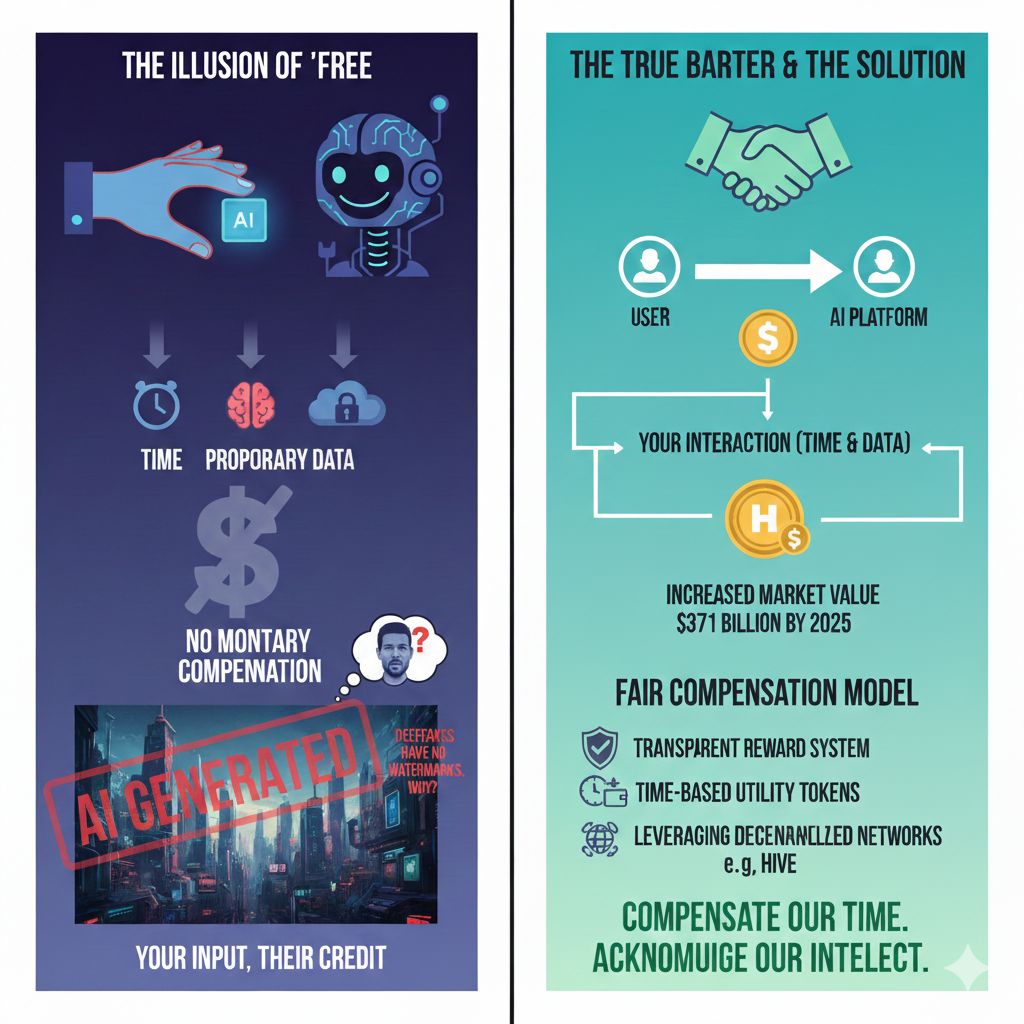
The Unseen Currency: Data, Time, and Effort Behind the Undervalued Liability
When engaging with “free” AI tools, users are not passive consumers; they are active participants. Our contribution serves as essential fuel for the AI’s advancement. While the output compensates for the effort (the transactional cost), two more valuable currencies—time and proprietary data—are surrendered without remuneration:
- The Uncompensated Asset: Every minute spent interacting and every piece of data shared enhances the model. Users are unpaid trainers. The AI is exhausting human capital to advance, increasing corporate value at the user’s expense.
The Crux: The output compensates for effort, but what about the strategic valuation of user time and proprietary data? The failure to compensate for AI user data, time, and effort creates a massive, latent liability.
The Paradox of Progress: Financial Injustice and Valuation Risk
The financial stakes in this system are colossal. In 2017, private investment in AI was around $28.4 billion. By the end of 2025, the global AI market is projected to skyrocket to approximately $371 billion (Source: MarketsandMarkets / Fortune Business Insights). This massive, exponential growth—fueled directly by continuous user interaction—begs the question: Who holds the equity?
The Watermark Hypocrisy: Erosion of Intellectual Credit
The increasing trend to tag content as “AI-Generated” or apply a watermark creates an ethical and market distortion. “You put all the effort into the AI, provide data, time, and efforts, and lastly, the output comes with a watermark! This is to show that the effort is not yours! Is this justified?” This practice undervalues human contribution. The argument that watermarks are for “security” collapses when we note: “When deepfake videos, photos, or audio of famous people are created, there is no watermark! Where does the security protocol go then?” This inconsistency points to a strategic measure to retain control over IP derived from user labor.
Mitigating Valuation Risk: The Imperative for Decentralized Compensation
The current barter system is transactional; for financial sustainability, it must shift toward an investment model. The failure to compensate for AI user data valuation and liability is a market failure waiting to be corrected by regulation or consumer backlash.
A Serious Question of Intent
The barrier to compensating users is not a technical one. Decentralized networks like Hive or Brave’s BAT Network, and various crypto platforms, already provide robust mechanisms to reward users for their contribution. This raises a serious, fundamental question for boards and shareholders: Given the existence of proven blockchain compensation frameworks, why are major AI companies deliberately choosing not to implement them? This represents a conscious decision to maximize short-term profit by carrying uncompensated liability.
Mandating Fair Compensation
To mitigate future risk, AI platforms must implement transparent reward systems—utility tokens or points—linked to user activity metrics (Interaction Duration and Data Contribution). These assets, tied to a secure crypto wallet, would formally recognize the long-term investment users make in the AI’s growth.
Conclusion
The age of “free” AI services is a dangerous illusion that distorts market valuation. Recognizing the AI user data valuation and liability is the first step towards sound corporate governance and an equitable digital future. CEOs and CFOs must urgently assess this strategic liability. We must demand that our role as essential contributors is recognized, both through a fair monetary reward system that utilizes existing crypto frameworks, and by acknowledging the human capital that truly drives AI advancement.